
Dog Trainer Courses UK: An Honest Comparison
You can become a “certified dog trainer” in the UK in 42 minutes. No dog required.
I’m not exaggerating. One online course listed on Reed right now runs to 0.7 hours, self-paced, certificate included. At the other end, the APDT’s ABTC-recognised Dog Training Instructor course takes two years. Both leave you able to call yourself qualified, because in the UK there’s no licence and no legal minimum. Anyone can print business cards tomorrow.
That’s the trouble with searching for dog trainer courses UK. Every result is somebody’s sales page, every one claims to be the gold standard, and none of them tells you what you’ll actually be able to do when you finish.
I’ve been on both sides of this. I got a Flat-coated retriever called Rolo without realising I’d brought home a gundog, and went looking for help that made sense. Since 2016 I’ve trained people to become dog trainers myself, so yes, I have a horse in this race. My prices sit in the table right alongside everyone else’s.
Below: different routes side by side, the real cost, the real hours with real dogs, what each certificate gives you, and the part many courses fail to teach you: How to get your first customers.
Dog Trainer Courses UK: Why “Certified” Can Mean 42 Minutes or Two Years
Before you compare a single price, you need to know what you’re comparing. Two courses can both say “certificate included” and have almost nothing in common.
Do you need a qualification to be a dog trainer in the UK?
No. There’s no government licence for dog trainers and no official body that issues a mandatory dog trainer licence. Legally, you could start teaching a puppy class on Saturday.
You won’t get far without proper training, though — and it’s not because anyone will check your certificate. In 16 years, I’ve been asked where I trained exactly twice. It matters because as a professional you have a responsibility.
Your clients. They’re trusting you with a dog they love and, often, a problem that’s upsetting them. Or a puppy they desperately want to train for real life. Most don’t ask where you trained, because they presume dog training is a regulated industry. That trust is yours to honour.
What makes people come back — and recommend you to everyone they know — is the results you get, how well you understand their dog, how you make them feel, the knowledge you can share, and the fact that you’ve clearly planned and prepared for every session. None of that comes from a piece of paper. All of it can be taught, and practised.
ABTC, OCN and CPD: What Dog Training Accreditation Actually Means
These three sets of letters get thrown around as if they mean the same thing. They don’t.
ABTC (Animal Behaviour and Training Council). The ABTC maintains voluntary professional registers for animal trainers and behaviour practitioners in the UK. It recognises courses that meet the Knowledge and Understanding requirements for specific roles, such as Animal Training Instructor. Alternatively, knowledge gained through previous training and experience can be assessed through its APEL route.
Practical skills must also be assessed by an ABTC Assessing Organisation. Once both requirements are met, practitioners can join an approved Practitioner Organisation and apply to be listed on the ABTC Practitioners Register, for which a separate annual fee applies.
OCN (Open College Network). This means the course has been externally verified by an awarding organisation. The IMDT, for example, is a registered learning centre and says all its courses are externally verified.
CPD (Continuing Professional Development) accreditation. This means a CPD body has reviewed the material as learning content. It doesn’t mean you’ve ever handled a dog in front of anyone. Most of the cheaper online bundles carry this label.
Now, the honest bit, because I believe in absolute openness: The NDTA’s programme isn’t on the ABTC recognised list. We are not accredited by OCN. I am a Fellow of the Institute of Occupational Learning – which shows, standards and quality matter to me.
Here’s what might matter for you.
You should choose an ABTC-recognised route if you want to be listed on the ABTC Practitioners Register, or you’re aiming at a role or organisation that asks for it. The APDT course and the university degrees on the ABTC list are the right choice for you, and I’d tell you that if you rang me.
If your goal is to run your own classes, teach your own clients and start earning within months rather than years, what you need is enough hands-on teaching practice, honest feedback and a plan for finding customers. That’s what we built our programme around.
So the real question isn’t “do I need a qualification?” It’s “what do I need to be able to do, and which course actually teaches it?” For each person this may be different, depending on your previous experience and knowledge.
Comparing Dog Trainer Courses UK
When I trained there weren’t the choices there are today. It’s important you make the choice that is right for you.
The table below is produced from my own findings in October 2026 and should be used as a guide. I strongly advise you to do your own research to get up-to-date-accurate information.
How much does a dog trainer course cost in the UK?
Anywhere from a few pounds to a few thousand. Here’s what that money actually buys:
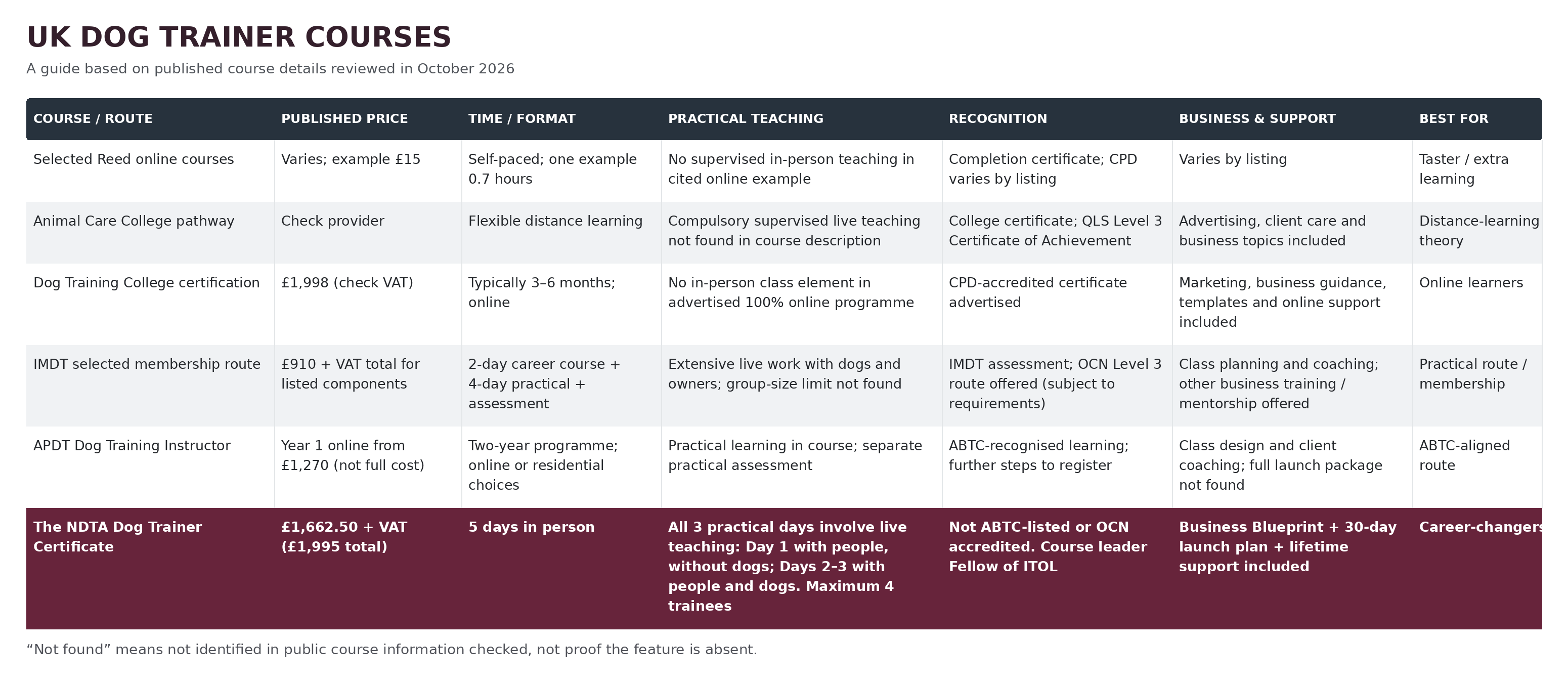
Here’s the column I’d ask you to look at twice: teaching practice with real dogs and people.
Training dogs is only part of the job. Most of it is teaching people — often worried, tired or embarrassed people — while their dog does exactly what they’ve told you it never does. You can’t learn that from a screen. Whichever course you choose, ask how many hours you’ll spend teaching real owners with real dogs, and how many other students will be competing for the tutor’s attention while you do it.
Our practical days run from 9am. Day 1 is about teaching in practice — trying out activities, planning sessions, and learning how to structure a class before you’re in front of real owners. Days 2 and 3 bring in real dogs and real people: perfecting your lesson plans, sharpening your teaching skills, and finding out exactly how it feels to run a group in a field when things don’t go quite to plan. Spoiler: they rarely do — and that’s the point. Time is split between teaching, structured feedback and lesson planning, so you leave not just having done it, but understanding why it worked.
With a maximum of four students, that works out at roughly £95 per hour of practical teaching — with the theory weekend, the Business Blueprint and lifetime support included on top. Run the same sum on any course you’re considering. It tells you more than the headline price.
Online Dog Training Courses With a Certificate: What You Get for Under £50
I’m not going to pretend cheaper online courses are worthless. They’re not. If you’re a dog owner who wants to understand your dog better, a dog walker adding a skill, or someone who wants a low-cost taster before deciding anything, a short CPD course is a perfectly sensible start.
Just be clear about what it isn’t. Most of the Reed listings run somewhere between under an hour and 28 hours, self-paced, with no practical element. You’ll come away knowing some terms. You won’t come away having stood in front of a group of people and dogs, all expecting you to teach them. Expecting you to show them how to train their dog or puppy. You won’t have had someone experienced beside you, telling you what you did well and what to do differently next time. You won’t have had feedback directly from the people you teach.
That gap, between knowing and doing, is where most new trainers either build confidence or quietly give up.
How much do dog trainers earn in the UK?
It depends almost entirely on what you run and how full it is. Here are my own numbers from running classes for years. They’re not a guarantee.
Group classes are the most profitable place to start. In my experience, you can make a net profit of £15–20 per dog, per class. A maximum of 8 dogs in a class is our suggestion. It will take time to fill classes of 8, but we also give you the training to progress your first customers into your next foundation class. We show you how to keep your customers on board. The numbers show why classes — not one-to-ones — are where I tell new trainers to aim for.
Can you become a dog trainer part-time?
Yes, and for most people it’s the smartest way to do it. Classes run on evenings and weekends, which is exactly when most owners are free. You can keep your income steady while you build skills, reputation and a waiting list, then decide when or whether to make the jump.
I know the fear because I had it. I had no idea, when I started, that it would become the business it is. What got me moving was taking small, practical first steps rather than one terrifying leap.
Which Route Fits You? A Three-Question Test
Answer these three questions honestly and the right route usually becomes obvious — even if it isn’t ours.
- Do you need or want to be on the ABTC register?
If you’re aiming for a role or organisation that asks for it, go down an ABTC-recognised route such as the APDT course or a degree from the ABTC list. Plan for it to take a couple of years. If you want to work for yourself, running your own classes, this matters much less than practical skill and a plan for finding clients.
- How much hands-on teaching do you need before you’ll feel ready?
If you’ve already taught groups of people with their dogs, a theory-led or online course may be enough to fill the gaps. If you haven’t, put practical hours and group size at the top of your list. Confidence comes from doing it in front of real people with someone experienced beside you.
- How soon do you need to earn or how soon do you want to get started?
If you need an income or want an income from training within weeks or months of your training, choose a course that teaches you to plan, price and fill a class — not just how dogs learn.
Here’s how that usually plays out:
Register first, time no object: APDT or an ABTC-recognised degree.
Recognised membership, comfortable travelling to multiple course dates: IMDT.
Testing the water, or adding a skill to another pet business: a short online course.
Career-changer who wants to run their own classes soon, with real practice and business support: this is who we built The NDTA programme for.
Two of our graduates show what that last route looks like in practice:
“Fi came to us wanting to leave her full-time job and build something of her own. She was one of our younger students. Fi took to teaching so naturally that by the day after her training finished, she was running a Week 1 puppy class for us. She didn’t wait — she launched within her first couple of weeks, added Training Walks to build income quickly, and later came back to complete our specialist Pet Gundog training. A few years on, she’s just taken delivery of her new sign-written van. That’s a proper business.”
“Jim is a consultant aircraft engineer — well-travelled, successful, but ready for something closer to home and closer to his heart. He already worked with his two gundogs and trained for a gundog club, but knew he needed to understand the teaching side before he could work with pet dog owners. A friend who’d trained with us pointed him our way. Jim started with 1:1s while he was between locations, then set up his classes once he’d moved. He came back to complete our specialist training too — not because he had to, but because he wanted to.”
Practical Dog Trainer Courses Near Me: Hampshire and the South
If you’re in Hampshire, Dorset, Wiltshire, Sussex or anywhere you can reach Southampton, you can train in person. We have had students from far and wide, include Malta and Mauritius. All our training takes place at our Hedge End venue (SO30 4BG), in groups of no more than four.
Why does in person matter so much? Because the hard part of this job doesn’t happen on a screen. It happens when a dog won’t settle, an owner’s confidence drops, and you’ve got to change your plan on the spot without the rest of the class noticing. Our practical days are built around exactly that: real dogs, real people, and plenty of things not going to plan.
Quick Answers
Am I too old to become a dog trainer?
No. There’s no age limit in this industry, and many people come to dog training as a second or third career. Life experience is a real advantage, because most of the job is reading people, staying calm and explaining things clearly. I was 50 when I started.
How long does it take to become a dog trainer in the UK?
It depends on the route. A short online course can take less than an hour. The IMDT route is a 2-day theory course, a 4-day practical course and a 1-day assessment. The APDT course takes two years. Our programme is five days in person, followed by lifetime support while you launch.
Can I study dog training online only?
You can learn the theory online, and lots of good material exists. You can’t learn to teach a group of real people with real dogs online. If you want to work with clients, make sure at least part of your training is in person, with feedback.
Do I need an ABTC-recognised qualification?
Only if you want to be on the ABTC Practitioners Register, or you’re aiming for a role that requires it. If you plan to run your own classes, clients will judge you on your results, your reviews and how you make them feel.
Is dog training a regulated profession in the UK?
No. There’s no government licence for dog trainers. That’s exactly why it’s worth checking what any course actually teaches you, and how much of it you’ll practise on real dogs, before you pay.
Your Next Step
The right course is the one that fits where you’re trying to get to. If that’s the ABTC register, take the longer route and do it properly. If it’s your own classes, your own clients and your own income, choose a course that gets you teaching real people early — and shows you how to get your first customers.
That’s why our groups are tiny and our practical days are long, and why every student leaves with a business plan as well as a certificate. Bethan, one of our graduates, put it better than I can:
“Sandra and the team were amazing! The abundance of knowledge and teaching skills they have to help others go into that line of business is second to none. I thoroughly enjoyed the training programme and left feeling confident to put it all into practice and start my own training business.”
Bethan, NDTA graduate
Five days. Four students maximum. Your first classes planned before you leave.
Want to see more of how I teach and think about dog training?
My YouTube playlist for aspiring dog trainers is a great place to start.
The Complete NDTA Dog Trainer Certificate Programme: £1,995. It includes a 2-day Theory Weekend, 3 intensive practical days with real dogs and real people, your Dog Trainer Business Blueprint with a 30-day launch plan, and lifetime support: monthly Zoom sessions, our WhatsApp group and professional training videos.
Check out available dates: Dog Trainer Certifcate Programme
Groups are capped at four.
Still not sure being a dog trainer is for you? Answer 5 short questions on our Assessment App.